
Software Used on this Project
Project Overview
The Reina Sofía is one of the most important museums in Madrid and Spain. With over 1.5 million visitors in 2024, it ranked among the 50 most visited museums globally. In recent years, the museum has received criticism from visitors regarding the negative user experience in some of its areas. In this context, the Reina Sofía Museum commissioned Arup to evaluate the user experience and propose a selection of actions to alleviate the current situation. Arup approached this study by leveraging its global network of experts, knowledge of the local context, and expertise in pedestrian planning and modelling with Oasys MassMotion, benchmarking, and best practices.
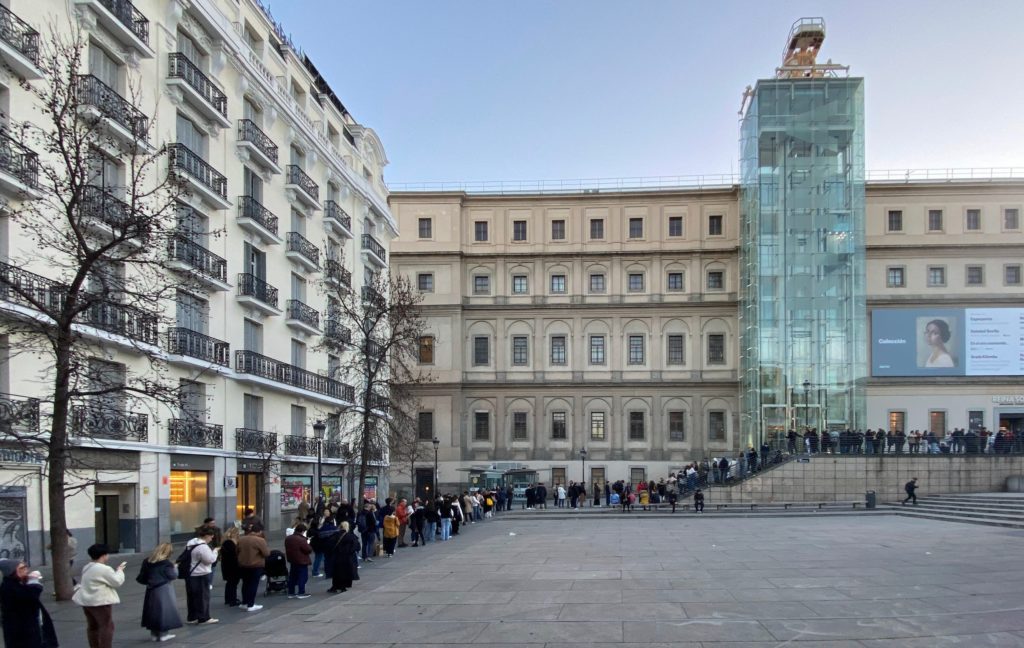
Visitors queueing in front of the main entrance of the Reina Sofía Museum
Visitor experience standards
To understand the main challenges and propose effective measures to improve the visitor experience, a benchmark of museum best practices was developed. The analysis considered multiple aspects of the visit, including approach to the museum, queuing, entry procedures, wayfinding, and indoor navigation. From this benchmark, it was established that waiting times exceeding 15 minutes negatively impact the visitor experience, whereas waiting less than 5 minutes is generally perceived as positive. The benchmark provided a reference framework for evaluating the museum’s current conditions and informed the development of pedestrian simulations used to test potential improvements.
How Oasys Proved Invaluable
To gain a deeper understanding of visitor access dynamics and identify strategies to mitigate crowding and long waiting times, pedestrian models of the entrances and the Guernica gallery were developed using Oasys MassMotion. A three-step approach was used where each model was calibrated with on-site observations and compared with ticket office records. Then, several scenarios were tested to evaluate hypotheses, leading to a series of recommendations.
Baseline – understanding the current situation
As a first step, a baseline model representing current conditions was built and calibrated using the collected data. In 2024, approximately 20% of visitors entering through the main building experienced long waiting times, while 50% enjoyed a positive experience. In contrast, at the lesser known Nouvel building entrance, 80% of visitors had a positive experience, and only 6% a negative one. It is important to note that some visitors who waited more than 15 minutes did so voluntarily in order to enter during free admission hours. A base scenario of each access was built and calibrated to match the conditions just described. Once the baseline was validated, several alternative configurations were simulated to explore potential interventions and quantify their effects on visitor flow.
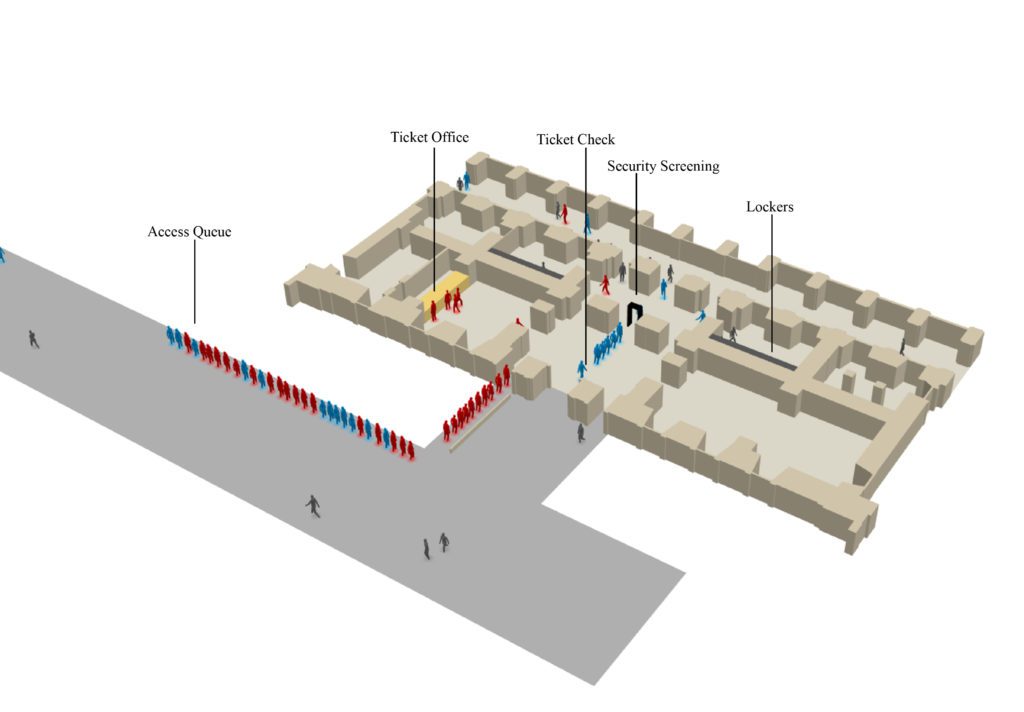
Main entrance – baseline model
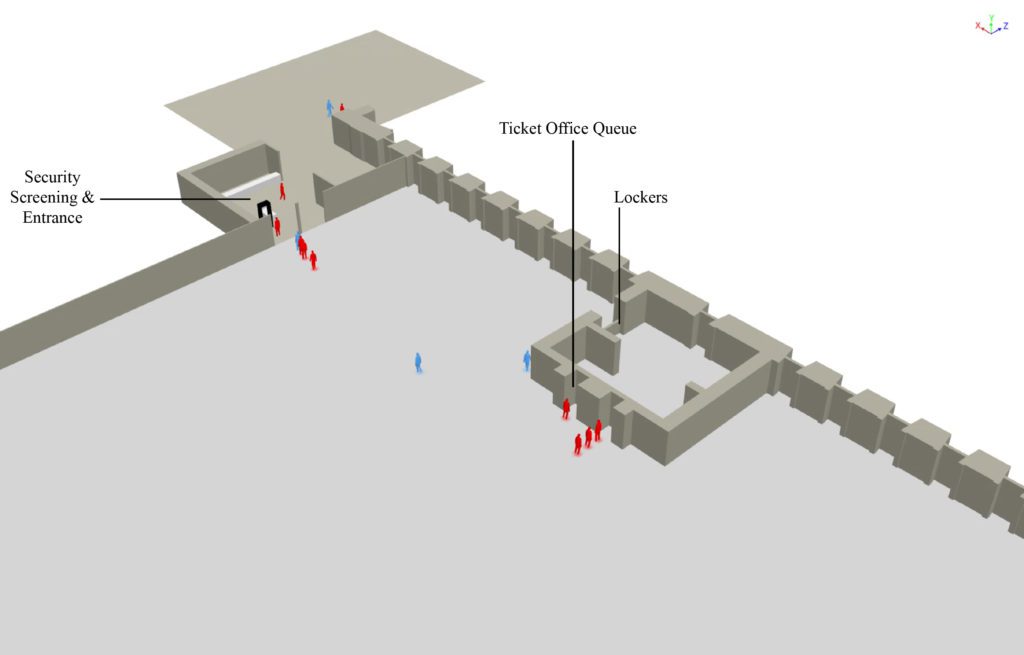
Nouvel entrance – baseline model
Scenario analysis – testing hypotheses
A series of simulation-based scenarios were developed to evaluate different operational strategies and their impact on visitor flow and experience. Each scenario represented a specific configuration of entry operation measures, including variations in ticketing, security control access distribution and crowd management strategies. These were compared against the baseline model representing the current operating conditions.
The comparative analysis focused on identifying actions capable of reducing queue lengths, waiting times, and crowd formations at the entrances and the Guernica Hall. By testing each configuration in MassMotion, it was possible to observe how changes in visitor processing capacity, spatial organization, and ticketing procedures influenced flow efficiency.
Through this approach, the simulation provided quantitative data that allowed the evaluation of the effectiveness of different strategies. The insights gained from this analysis formed the basis for the development of recommendations to improve access, comfort, and efficiency.
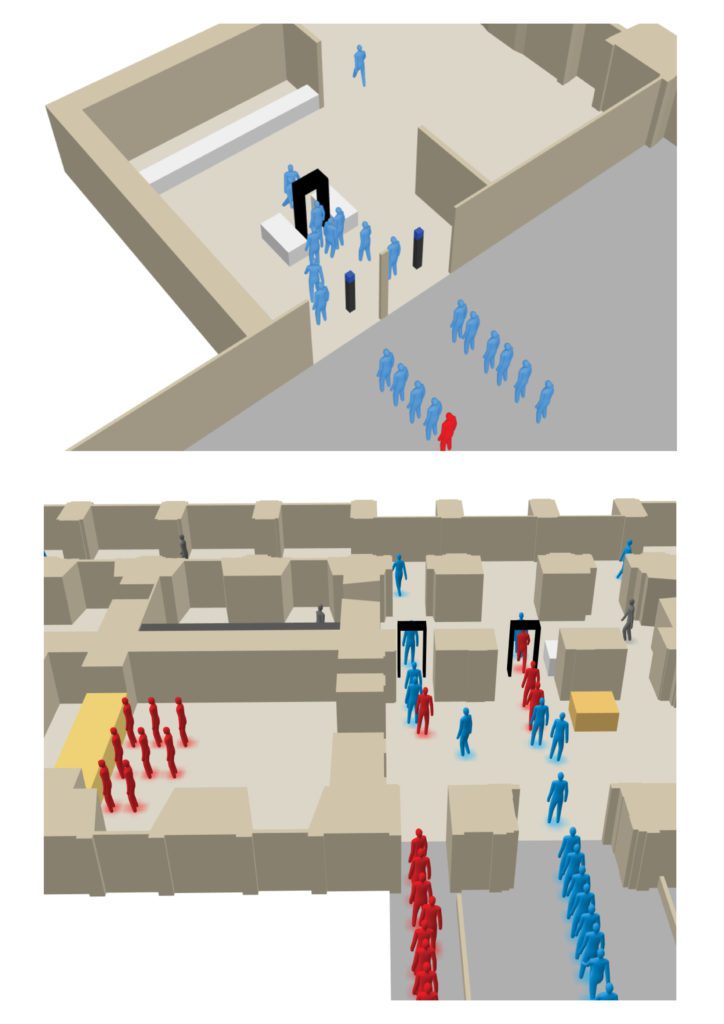
Examples of model scenarios tested in the Guernica Hall and the entrances
Developing recommendations
Building on the scenario analysis, a series of recommendations were developed to improve visitor access and flow management. The results highlighted the importance of balancing demand distribution, optimizing entry infrastructure, and promoting pre-purchased or online tickets to achieve a smoother access process and an improved overall experience. Several recommendations on terms of spatial layout and operations were formulated in packages of short, medium and long-term actions.
Summary and key learnings
Through pedestrian simulation and the use of MassMotion, it was possible to quantitatively assess the impact of different operational strategies on visitor experience. The results allowed us to identify measures such as increasing online ticket sales or optimising the distribution of entry points that can substantially reduce waiting times and enhance the overall quality of the museum visitor experience.
We’d like to thank Junior Transport Planner, Matias Cardoso, at Arup for sharing this work with us.
Explore the extensive capabilities of our leading pedestrian simulation software – register your interest to speak to a member of team.