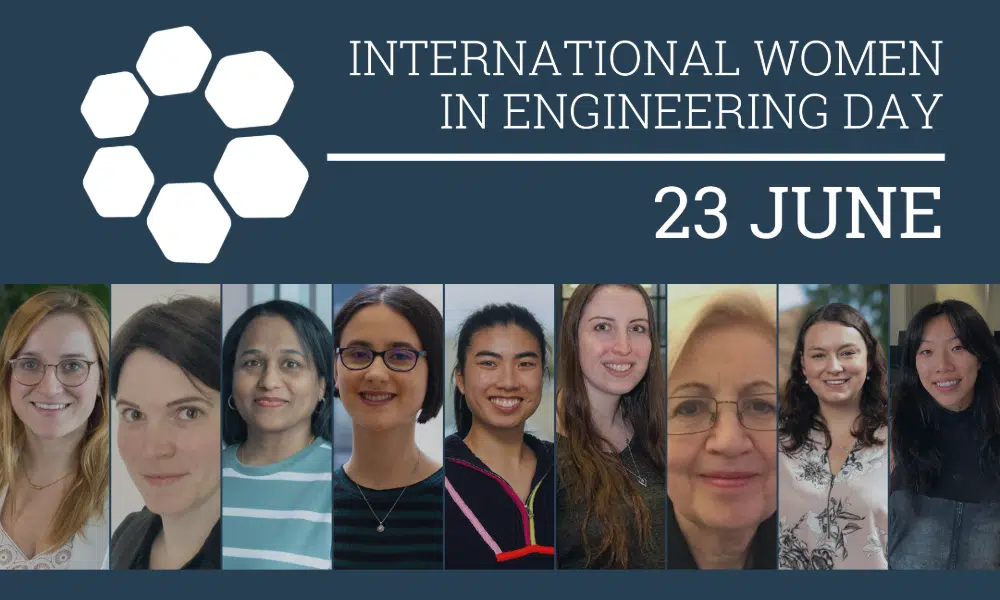
Progress for women in engineering and software development is often measured in numbers: more women studying STEM subjects, more women entering engineering careers and more women visible in technical teams. While those numbers matter, the reflections shared for International Women in Engineering Day (INWED) 2026 show that progress is also about something deeper: belonging.
Belonging changes how people learn, contribute and lead. It helps women move from feeling like the exception to feeling part of the profession. It also strengthens engineering itself, because teams that include a wider range of experiences are better equipped to understand the people and places they design for.
More women entering engineering and software development
For Arup Data Scientist, Hannah Mehr, the shift from isolation to belonging has been significant. “There’s been a real shift in visibility and representation. Thanks to the STEM and apprentice ambassadors, alongside role models across the industry, more women are entering the field. Apprenticeships in particular have opened doors - my degree and master’s cohorts are close to 50% women. At work, I’ve been supported by incredible mentors, peers and managers, and networks like Digital Women and Connect Women within Arup create spaces to learn, connect and support each other. It feels normal to belong here.”
That phrase, “It feels normal to belong here,” captures the importance of representation in STEM. It is not only about encouraging girls and young women to choose computer science, engineering or software development. It’s about making sure that, once they arrive, they are supported, valued and able to grow.
Oasys Structural Applications Specialist, Shirley Feng, has also seen this shift in education and industry: “The biggest shift I have seen in the experience of women is the growing number of women in STEM and STEM leadership. In my own experience, when I first started studying engineering, I did not expect the number of women who were there, I was surprised to see how many women wanted to study engineering like me. This has carried over into my experience in industry where I have worked with many women engineers on projects.”
These experiences show how visibility can become momentum. When more women study engineering, join technical teams and take on leadership responsibilities, they help create a profession where future women engineers and software developers can see a place for themselves.
Support networks and open conversations
Oasys Geotechnical Applications Specialist, Sissira Pereira, describes a positive shift towards more inclusive engineering cultures: “In recent years, through my experience in the engineering field, I have seen a positive shift towards greater representation, stronger support networks, and more open conversations around inclusion. Many organisations like Arup are now actively embedding diversity into how teams work and collaborate which is a meaningful step forward.”
Arup Transport Planner, Paula Godoy, also highlights the value of naming challenges clearly. “There has been a positive shift in both visibility and entry into the field, alongside a growing openness to name and discuss challenges. Giving a name to issues such as progression barriers, work–life balance, and the reality that many women carry dual roles helps validate shared experiences, build confidence, and raise awareness across the industry.”
This openness matters. Conversations about women in STEM, diversity in engineering and inclusive workplace culture are not simply awareness exercises. They help identify what needs to change, where support is working and how organisations can retain more women in technical careers.
Mentorship that expands what feels possible
Mentorship is another recurring theme. For DC Partnership Crowd Modeller and Senior Consultant, Olivia Yee, the women who mentored her during an early internship had a lasting impact on her confidence and career direction. “What stands out to me most are the women who led, supported and mentored me through that internship. Sharing their knowledge and encouraging me to ask questions. Their confidence and willingness to invest in my growth has left a lasting impression on me. Seeing women excel in both technical and leadership roles certainly gave me the confidence to pursue opportunities that once felt beyond my reach.”
Mentorship can be one of the most practical forms of representation. It turns visibility into guidance. It gives early-career women engineers and software developers someone to learn from, ask questions of and imagine themselves becoming.
Diverse perspectives create better engineering outcomes
Representation is not only about fairness. It also improves the quality of engineering design and decision-making. Arup Senior Engineer, Saoirse Goodwin, puts this clearly: “There are generally more women in STEM, especially across industry, and it shows. Having diverse perspectives in design leads to better outcomes for everyone – women are generally more conscious of the need for well-lit streets at night, and their perspectives and design decisions feed into safer urban environments.”
Inclusive engineering is stronger engineering. Whether designing safer public spaces, developing engineering software, modelling complex systems or improving digital workflows, diverse teams are more likely to ask better questions and identify needs that might otherwise be missed.
Arup Transport Planner, Emily Wade’s, reflection also shows how broad the world of STEM can be once those pathways become visible. “I have a master’s within the Computer Science field and use the principles in my work daily, working alongside many women I admire and respect. Awareness of the broadness of STEM and watching an increase of women succeed in these areas has been powerful and we should encourage the continuation of this.”
Engineering intelligence is inclusive intelligence
For INWED 2026, Engineering Intelligence is a powerful theme because it recognises that engineering expertise is not only technical, but also human. It’s the ability to combine analysis with judgement, creativity with collaboration, and software or engineering tools with real-world understanding.
The women featured in our blog series show that visibility, support networks, mentorship and inclusive design are not separate from engineering excellence. They are part of how engineering becomes more intelligent, more responsive and more useful to the people it serves.
In the next blog post in this INWED 2026 series, we look ahead to the next 50 years of women in engineering, software development and STEM, exploring leadership, retention, AI, flexible working and the future of engineering intelligence.
Voices of women in STEM
Read the other blog posts in this three-part series.