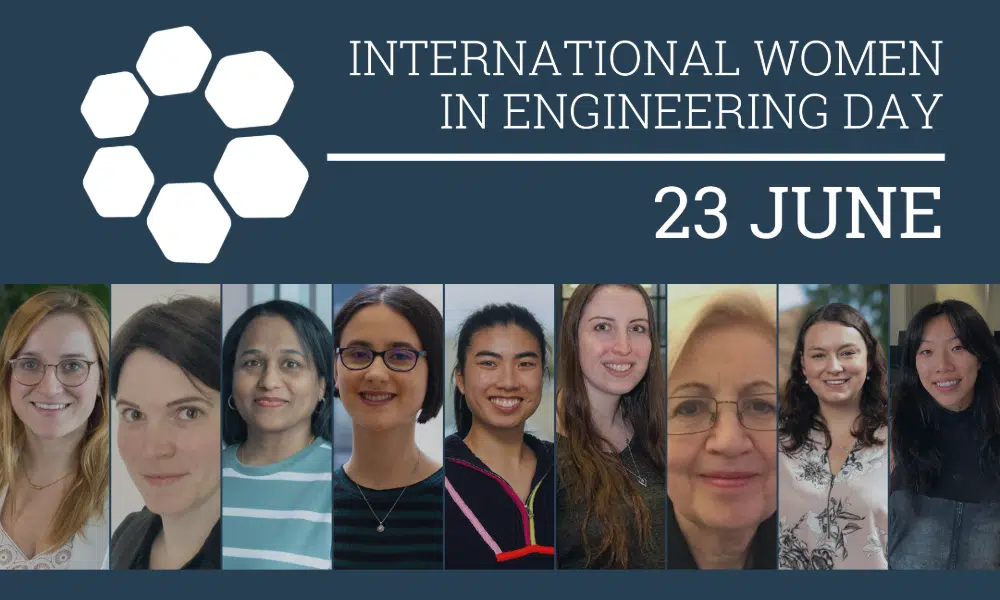
International Women in Engineering Day (INWED) is a moment to celebrate the achievements of women engineers and STEM professionals. It is also a moment to look honestly at the conditions that shaped their journeys.
For INWED 2026, the theme is Engineering Intelligence: a reminder that engineering excellence depends on more than technical skill. It also depends on creativity, judgement, leadership and the breadth of perspectives needed to solve real-world problems.
As engineering and software development have evolved over the past 50 years, so too have the experiences of the people shaping them. New technologies have transformed how we design, analyse and deliver projects. But just as importantly, there has been a quieter shift, one that speaks to visibility, opportunity and belonging for women working across STEM.
As we mark the occasion and celebrate 50 years of Oasys, we asked colleagues and friends of the Oasys community to reflect on the biggest shifts they have seen in the experience of women in STEM over the last five decades. Their reflections highlight meaningful progress, but also why visibility, access and representation still matter and a shared understanding that there is more to do.
Looking back: From isolation to visibility
One of the clearest themes in the responses is visibility. Over the last 50 years, the experience of women in engineering and software development has shifted significantly, but the starting point, for many, was one of low visibility, limited access, and a sense of isolation.
Across the responses, a consistent picture emerges - entering STEM fields often meant stepping into spaces where women were underrepresented, unsupported, and frequently overlooked.
Arup Data Scientist, Hannah Mehr, recalls being one of very few women in the room: “When I was at school, very few girls chose computer science. During my Level 3 apprenticeship, I was the only woman in my class. It often felt like I had to navigate the space alone, without many people who shared my experience. I felt like I had to constantly prove myself - both because of my gender and age.”
Arup Transport Planner, Emily Wade, describes a similar lack of early exposure to computer science: “When I first looked at my choice of A-levels I didn’t even consider taking up Computer Science, I didn’t understand what it was and couldn’t see many women involved in it so wasn’t interested.”
Beyond access, there were also challenges that weren’t openly discussed such as barriers around progression and work-life balance that often went unspoken, as Arup Transport Planner, Paula Godoy, explains, “Many of the challenges women faced in STEM were less visible and rarely discussed, particularly around career progression and balancing professional and personal responsibilities.”
Experiences like this were not uncommon. A lack of visible role models and fewer pathways into engineering and software meant that many women had to carve their own path, often while feeling the need to show evidence that they deserved to be there.
It’s clear that the last 50 years of progress in STEM isn’t just about advancements in tools, systems or digital capabilities. These reflections highlight a simple but important truth: a lack of representation in STEM roles makes it harder to imagine those careers as places where women can belong.
Barriers that were present, but not always named
Several contributors reflected on the structural and cultural barriers women in STEM have faced, particularly around progression, confidence and balancing professional and personal responsibilities.
Paula notes that, “many of the challenges women faced in STEM were less visible and rarely discussed, particularly around career progression and balancing professional and personal responsibilities.” Oasys Geotechnical Applications Specialist, Sissira Pereira, also reflects that, “women in STEM often faced limited access, fewer role models, and barriers to progression.”
For Arup Senior Engineer, Saoirse Goodwin, limited representation did not only affect who entered engineering. It also affected what engineering produced: “For much of the past 50 years, engineering and software development were overwhelmingly male spaces, and the built environment reflected that; everything from restroom apportionment to urban safety was shaped by a narrow set of assumptions about who uses it and how.”
That perspective is central to inclusive engineering. When the people designing buildings, infrastructure, software and systems come from a narrow range of experiences, the outcomes can reflect those limits. Engineering intelligence depends on widening that perspective.
Changing expectations of what women can become
For some contributors, the barriers were also social. DC Partnership Crowd Modeller and Senior Consultant, Olivia Yee, reflects on the expectations placed on her when she was younger: “In my formative years, I was reminded by my grandmother to marry and rely on a rich man, focus on beauty and learn how to cook. I may have taken on some of that advice but succeeding in marrying and relying on a rich man still remains questionable.”
Her reflection brings warmth and humour to a serious point. For many women, entering engineering, technology or software careers has also meant challenging assumptions about ambition, leadership and what their future should look like.
Arup Fellow, Helen Campbell, reflects on her experience moving into the digital space, “I’ve been a software engineer all my working life. When I started, it was a relatively small field mostly located in universities and a handful of big companies like IBM. My uncle told me to give it up because he didn’t think it had a future!”
Looking back over the last 50 years, the biggest shift has not only been technological. It has also been cultural. Women in engineering and software development have helped redefine who belongs in technical spaces, what expertise looks like and why representation matters.
Why looking back matters
Reflecting on the past is not about focusing only on what was difficult. It’s about understanding the barriers that shaped women’s experiences in engineering and STEM, so the next generation doesn’t have to face the same ones.
The women who shared their reflections are part of a wider story of change across STEM: more visibility, broader career pathways, stronger conversations about inclusion and a growing recognition that diverse perspectives improve engineering outcomes.
The next blog in this INWED 2026 series explores where women in engineering and software development are now, and how visibility, mentoring, support networks and inclusive design are shaping a stronger future for STEM.
Voices of women in STEM
Read the other blog posts in this three-part series.