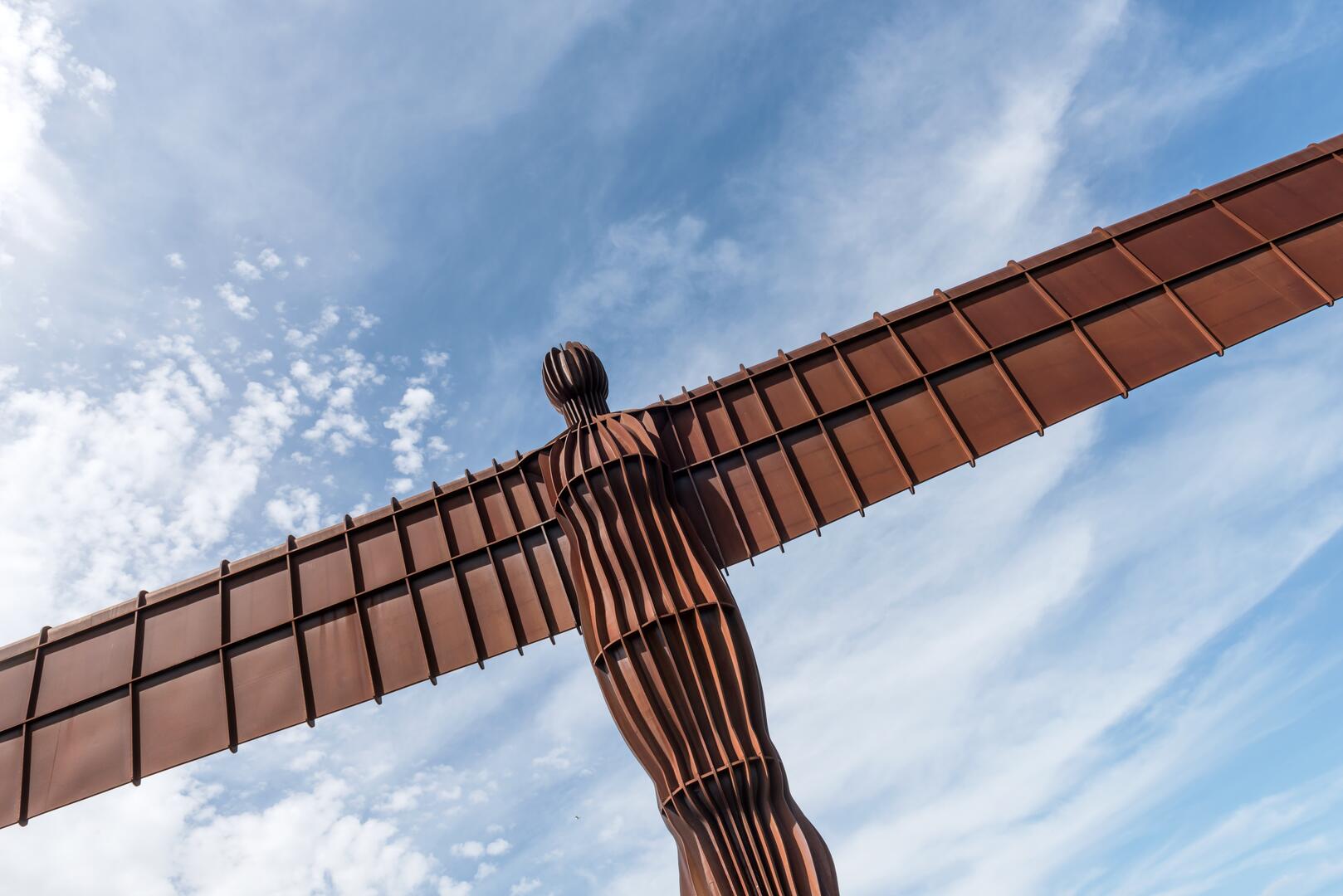
Rising above Gateshead with its unmistakable silhouette, the Angel of the North has watched over the A1 for more than two decades - an enduring symbol of Northern ambition and engineering ingenuity. Just as the steel‑and‑copper giant continues to command the landscape, Oasys has remained a quiet force behind projects shaping human spaces across the region and far beyond for five decades. And the connection runs deeper than symbolism: back in the 1990s, Arup engineers used Oasys software to model, analyse, and bring this now‑iconic landmark to life.
The initial design was created by artist Antony Gormley, commissioned by Gateshead Council and funded by the National Lottery. Completed in 1998, the iconic structure is the result of brilliant artist design, extensive structural analysis and design. Arup engineers used in house powerful structural analysis and design capabilities for the design contributing towards its resilience to weather conditions and ground conditions over the past two decades. Award winning, breath taking and enormous, the Angel of the North proves to be a structurally sound piece of artwork that is now an integral part of Northeast England.

With a wingspan bigger than a Boeing 757 and able to withstand winds of over 100mph in its exposed hilltop location, the steel sculpture stands 20m tall on the site of a former coal mine between the A1 and A167 adjacent to the road interchange.
Antony had the idea of creating ‘The Angel’ using heavy industrial and shipbuilding techniques to construct a material image of a spiritual being. The inner body is a plate modelled of Antony’s own body. Gormley created the 3D design model of the sculpture by scanning his own body using innovative geomatics and plotting coordinates to create a virtual ‘angel’. The body weighs 100 tonnes and the two wings each weigh 50 tonnes.
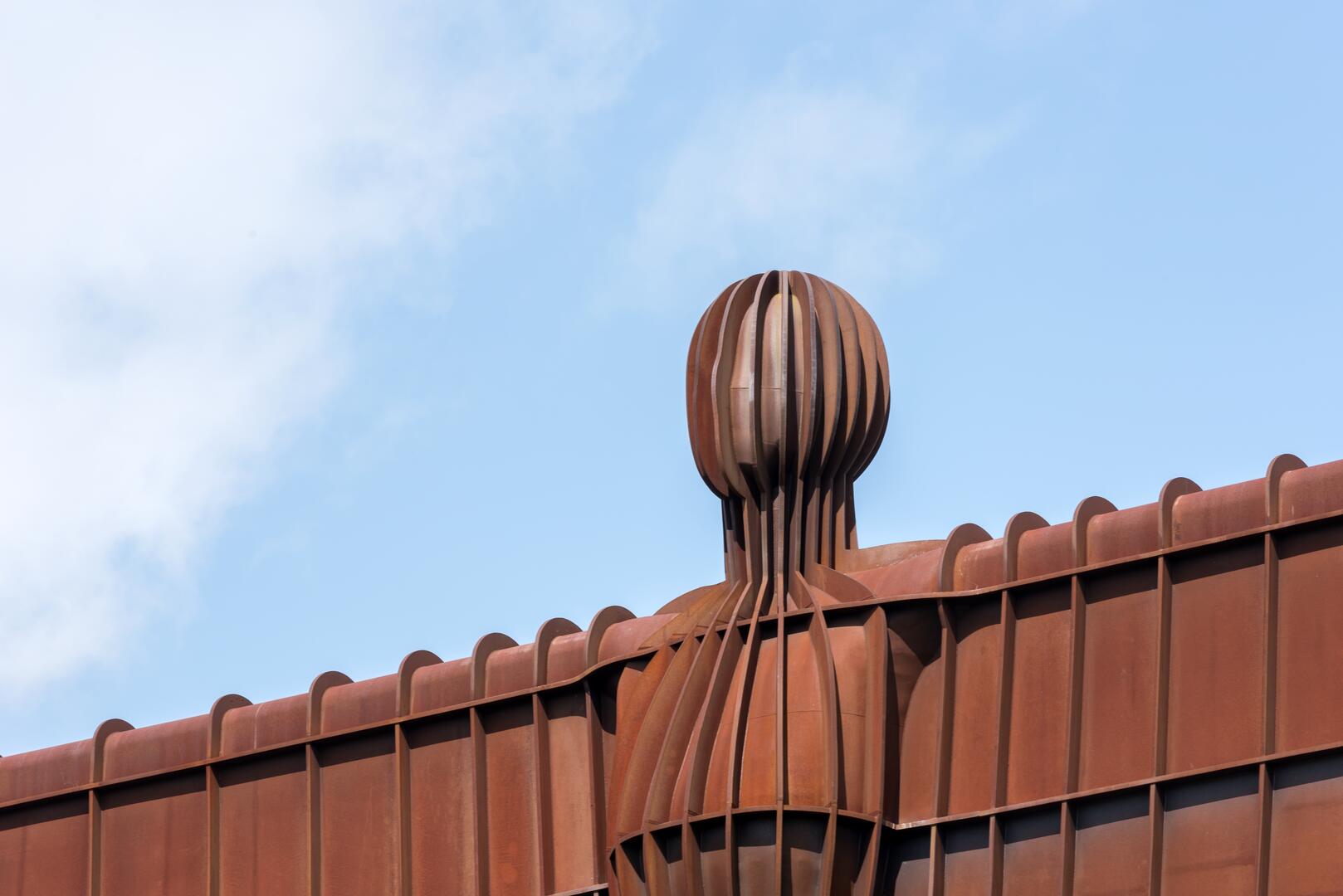
Structural engineering
Once the scale and form of The Angel had been decided, Gateshead Council commissioned Arup’s Newcastle office to advise on the structural design. A common challenge many engineers face is ensuring a structure will remain standing in all conditions. The main problem of The Angel was its ability to withstand wind. The structure stands on a hill, meaning it is even more susceptible to high winds. We know that when we try to balance ourselves in the wind, we must move our body to avoid falling over. As The Angel is unable to move and the wings offer a huge amount of resistance to the wind, the design of the structure had to cater towards that element precisely.
The most critical part of the structure is the ankles where the forces to be resisted are large, but the cross-section is small. When wind blows on The Angel’s front, it is resisted by the tension in the shins and compression in the heels. The distance between the heel and shin had to be as large as possible to the shins and compression in the heels. The distance between the heel and shin had to be as large as possible to minimise these forces. The visible vertical ‘ribs’ and the ‘skin’ of the body also help to carry the wind forces and in particular helps to resist the twisting of the body when a gust of wind hits one wing only.
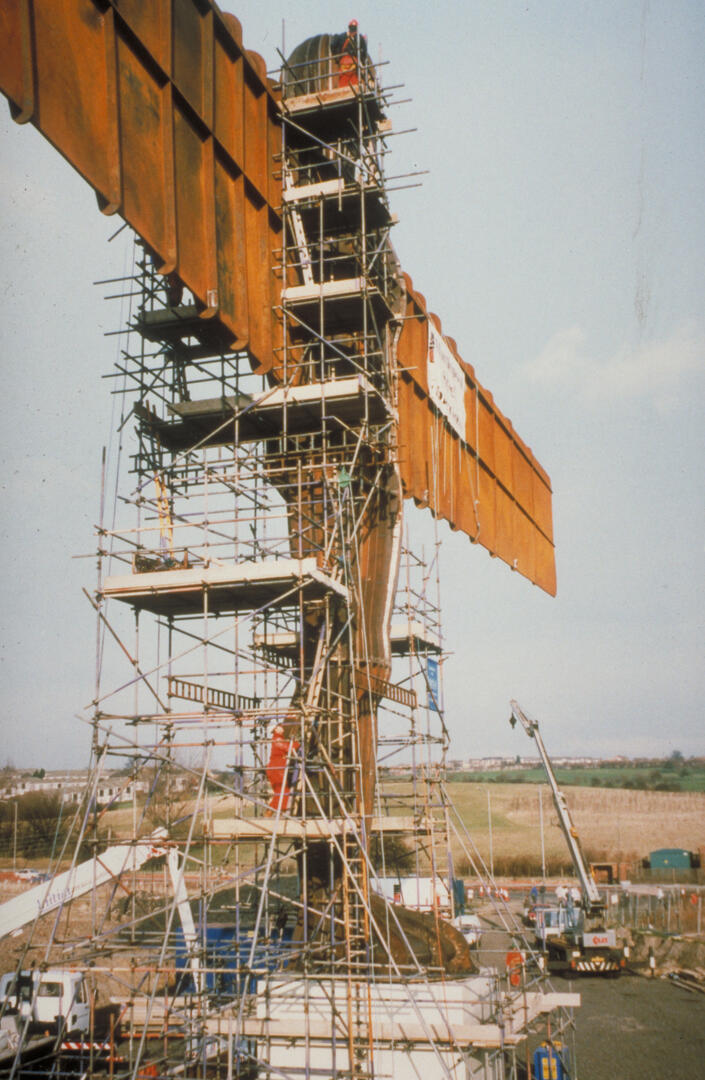
Arup developed the final design of the body and wings, refining the earlier calculations of the plate thickness and working out the whole shape would be defined for fabrication. The data for the body was scanned into a computer while the wings were defined geometrically on the drawings.
Geotechnical engineering
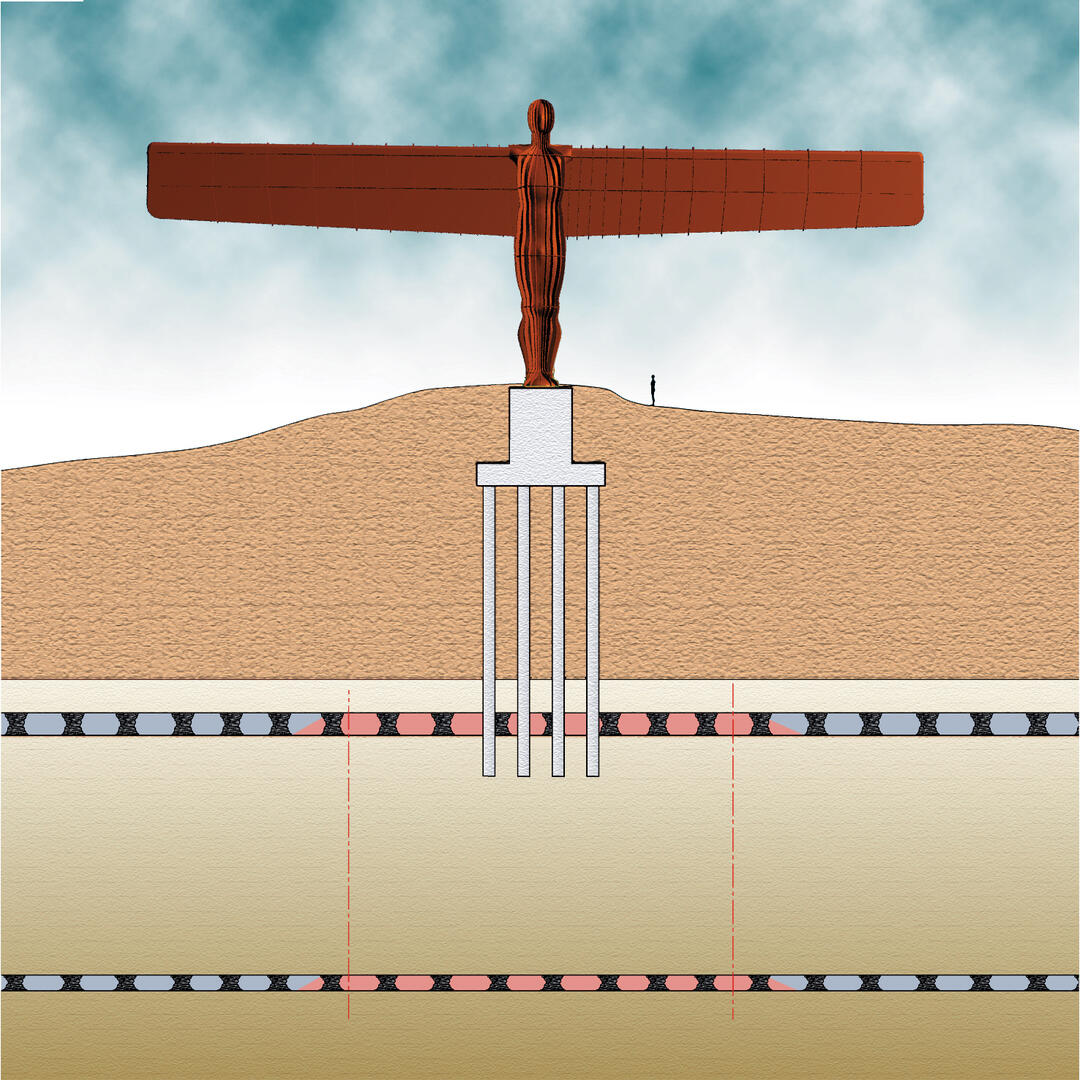
The sculpture stands on a site that was once a colliery pit head, reclaimed and capped with up to 15 metres of fill over the rockhead. Site investigations revealed two coal seams beneath the area, requiring stabilisation before construction could begin. As part of the foundation works, grouting was carried out to secure the old mine workings. This involved drilling 100 holes, each 33 metres deep through soil and rock, and injecting a sand–cement mixture.
For the main foundation, 750 mm diameter bored piles were selected, designed to end-bear on the underlying rock. Eight piles were drilled to a depth of 20 metres and filled with reinforced concrete. These were tied together with a substantial concrete pile cap measuring 12 metres long, 8 metres wide, and 1.5 metres thick, ensuring all piles remain in compression even under extreme wind loads.
Above this, a 4-metre-high concrete pedestal was constructed to support the sculpture. Once complete, the pedestal was buried so that the Angel appears to rise naturally from the hill. To secure the structure, 52 holding-down bolts, each 50 mm in diameter and 3 metres long, were cast into the pedestal using a precision template aligned with the sculpture’s base plate.
Angel of the North project
Read more about the project on the Arup website.
Software for structural and geotechnical engineers
Find out more about our Structural engineering software and Geotechnical engineering software.